Chesnok Red Garlic Hardneck Basaltic Farms

Chesnok Red Garlic

CCOF & USDA Certified Organic

Grown at Basaltic Farms in rich, volcanic soil, Chesnok Red is a premium, hardneck garlic variety bred for exceptional performance, rich flavor, and versatility. Perfect for planting or cooking, this certified organic garlic is a must-have for serious growers, chefs, and health-conscious home cooks seeking garlic they can trust.

Chesnok has between 5 and 8 bulbs per pound. Each bulb has between 12 and 18 seeds


(LBS) Bulk Discount Garlic Seed Price
5 $0.25 Off
10 $0.50 Off
25 $1.00 Off
50 $1.50 Off
100 $2.00 Off


Now taking Pre-Orders for the 2026 Season!
Orders Begin shipping in September.

ASK A Question

ASK A QUESTION

"*" indicates required fields

This field is for validation purposes and should be left unchanged.
Name*

Basaltic Farms Reviews

⭐ Customer Testimonials Here’s what customers say about our certified organic garlic. Read verified reviews from organic enthusiasts and chefs.

Frequently Asked Questions About Chesnok Red

Chesnok Red is one of our most popular hardneck varieties, beloved for its complex flavor profile and reliable growing performance in northern climates. Whether you’re a home gardener seeking exceptional seed garlic for planting or a culinary enthusiast drawn to its sweet, roasted flavor and beautiful purple striping, this variety delivers outstanding results. Here are the most common questions we receive about growing, harvesting, and enjoying this remarkable purple stripe garlic variety.

Growing Success for Seed Garlic Buyers

What makes Chesnok Red ideal for seed garlic planting?

Chesnok Red is a reliable hardneck variety that produces consistent, large bulbs with 4-6 easy-to-plant cloves. Our volcanic soil seed garlic has proven genetics, strong disease resistance, and excellent cold tolerance. Each bulb typically yields 4-6 planting cloves that will grow into full-sized bulbs the following summer.

Which growing zones give the best results for Chesnok Red seed garlic?

Chesnok Red thrives in USDA Zones 3-7 where it receives proper cold vernalization. Northern climates produce the most flavorful, well-developed bulbs. If you’re in Zone 8, pre-chill your seed garlic for 8+ weeks at 32-40°F before planting for best results.

When should I plant Chesnok Red seed garlic for maximum bulb size?

Plant 4-6 weeks before your first hard frost. Zones 3-5: early September to early October; Zones 6-7: mid-September to mid-October; Zone 8: mid-October to early November with pre-chilling. Early planting allows stronger root development and larger harvest bulbs.

Growing & Scapes

What does Chesnok Red garlic taste like compared to store-bought garlic?

Chesnok Red offers a complex, rich flavor with sweet undertones when roasted and a pleasant heat when raw. Unlike bland store-bought garlic, it has deep, earthy notes with hints of nuttiness. The volcanic soil adds mineral complexity you won’t find in commercial varieties.

How does Chesnok Red's flavor compare to other hardneck varieties like Music or German White?

Chesnok Red is milder and sweeter than the intense heat of Music or German White. It offers more complex flavor layers with beautiful purple striping. Raw, it has moderate heat; roasted, it becomes sweet and creamy. It’s perfect for those who want hardneck complexity without overwhelming spiciness.
What are the best culinary uses for Chesnok Red’s unique flavor profile? Chesnok Red excels in roasting whole, where its sweetness shines. Raw, it’s perfect for aioli, pesto, and salsas without overpowering other ingredients. Its balanced heat makes it ideal for sautéing, braising, and slow-cooking dishes where you want rich garlic flavor without excessive bite.

What are the best culinary uses for Chesnok Red's unique flavor profile?

Chesnok Red excels in roasting whole, where its sweetness shines. Raw, it’s perfect for aioli, pesto, and salsas without overpowering other ingredients. Its balanced heat makes it ideal for sautéing, braising, and slow-cooking dishes where you want rich garlic flavor without excessive bite.

Varieties & Selection

Does Chesnok Red produce scapes, and how does this affect my growing plans?

Yes, Chesnok Red produces curly scapes in late spring that should be removed to maximize bulb size. Harvesting scapes increases bulb size by 30% while giving you a bonus spring crop. The scapes have a mild garlic flavor perfect for stir-fries and pestos.

How does Chesnok Red perform in different soil types and climates?

Chesnok Red adapts well to various soil types but thrives in well-draining, mineral-rich soils like our volcanic ground. It requires strong vernalization (cold exposure) and performs best with consistent moisture through spring. It’s more cold-hardy than heat-tolerant, making it ideal for northern gardens.

What's the difference between Chesnok Red seed garlic and culinary garlic from Basaltic Farms?

There’s no quality difference – all our Chesnok Red is certified organic, disease-free, and perfect for planting or eating. “Seed garlic” simply indicates your intended use. You can plant what you don’t eat and eat what you don’t plant immediately. Every bulb meets the same high standards.

Storage, Harvest & Customer Support

How long will Chesnok Red store after harvest, and what affects storage life?

Properly cured Chesnok Red stores 5-6 months in cool (55-65°F), dry conditions with good airflow. Our volcanic soil produces garlic with excellent storage qualities. Avoid plastic bags or refrigeration unless peeled. Use paper bags, mesh bags, or clay garlic keepers for optimal storage.

When do you harvest and ship Chesnok Red, and what should I expect?

We harvest Chesnok Red in mid-July when 5-6 green leaves remain. After 3-4 weeks of field curing, we ship from August through February. Your garlic arrives fully cured, cleaned, and ready to plant or use. Each bulb is hand-selected for size, quality, and viability.

What guarantee do you offer on Chesnok Red seed garlic viability?

We guarantee all Chesnok Red seed garlic will be viable for planting when stored properly. If you’re not satisfied with germination or quality within 30 days of delivery, contact us for replacement or refund. Our volcanic soil genetics and careful handling ensure strong, healthy seed garlic that performs reliably in your garden.
Regan Jaxson Zack Kevin Team Shot Basaltic Farms

Why Choose Our Chesnok Red Garlic

At Basaltic Farms, our approach to growing Chesnok Red reflects our commitment to exceptional flavor and premium-quality seed garlic. When you choose our organic garlic farm, you’re getting one of the finest purple stripe varieties available.

  •  Perfect for Northern Gardens – Chesnok Red thrives in zones 3-7, developing complex sweet flavors through proper cold vernalization. Our 3,100-foot elevation provides ideal growing conditions this variety needs.
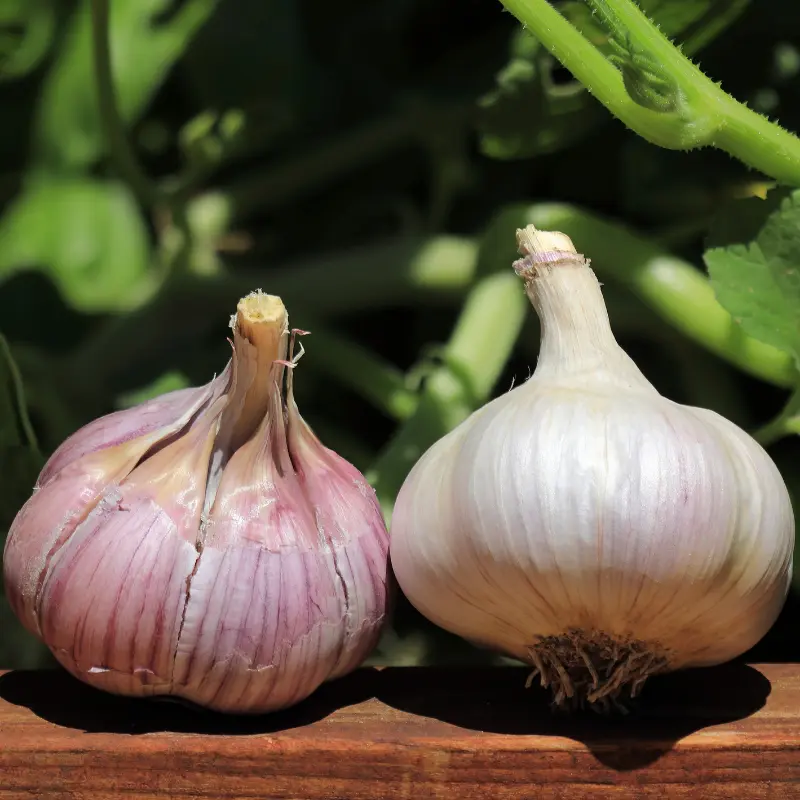
  •  Beautiful Purple Striping – This stunning variety produces attractive purple-streaked bulbs with 4-6 large, easy-to-peel cloves. The visual appeal makes it perfect for both culinary presentation and seed garlic planting.
  •  Sweet Roasted Flavor – Unlike harsh store-bought garlic, Chesnok Red offers mild heat when raw and incredible sweetness when roasted. Our volcanic soil enhances its naturally complex, nutty undertones.
  •  Reliable Seed Garlic Performance – Each bulb produces 4-6 substantial planting cloves that consistently grow into full-sized bulbs. Our hand-selected seed garlic ensures strong germination and healthy plant development.
  •  Triple-Certified Quality – Every Chesnok Red bulb is CCOF and USDA certified organic, plus Real Organic Project verified, ensuring zero synthetic inputs and complete growing transparency.

Note: Requires 40+ days below 40°F for proper bulb formation.

Fresh Healthy Organic Garlic Bulbs Basaltic Farms

Health Benefits of Garlic

Garlic has been valued as both a food and a traditional remedy for thousands of years across nearly every culture that had access to it. Modern research has started to catch up with what people have known for a long time — garlic is one of the more nutrient-dense foods you can add to your diet. The compounds responsible for garlic's strong aroma and flavor are the same ones researchers have been studying for potential health benefits.

  • Natural Allicin Content – When garlic is crushed or chopped, it produces allicin, the sulfur compound responsible for that unmistakable garlic smell. Allicin is also what most of the research around garlic's health properties has focused on.
  • Heart-Healthy Choice – Garlic has a long history of use in supporting cardiovascular wellness. Multiple studies have looked at garlic's potential role in supporting healthy cholesterol levels and blood pressure as part of a balanced diet.
  • Antioxidant Properties – Garlic contains compounds that may help protect cells from oxidative stress, including organosulfur compounds and flavonoids.
  • Traditional Wellness Food – Garlic has been used in folk medicine traditions worldwide for centuries, from ancient Egyptian laborers to traditional Chinese medicine to European herbalism.
  • Nutrient Dense – Garlic provides manganese, vitamin B6, vitamin C, selenium, and fiber relative to its size. It packs a surprising amount of nutrition into a small package.

Worth Mentioning (Anecdotal and Traditional — Not Verified by Modern Science):

Throughout history, garlic has picked up a pretty wild reputation that goes well beyond what clinical studies have confirmed. These claims are anecdotal or rooted in folk tradition and should be taken for what they are — interesting stories, not medical advice:

  • Ancient Egyptian builders were reportedly given daily garlic rations to maintain strength and endurance during construction of the pyramids. When the garlic supply was cut, workers allegedly staged one of the earliest recorded labor strikes.
  • Roman soldiers and gladiators consumed garlic before battle, believing it gave them courage and physical stamina. They called it "the stinking rose" and considered it essential military provisions.
  • During both World Wars, garlic was used as a field antiseptic when conventional medical supplies ran short. Soldiers applied crushed garlic to wounds to help prevent infection — a practice sometimes called "Russian penicillin."
  • In traditional Chinese medicine, garlic has been prescribed for respiratory ailments, digestive issues, and as a general tonic for over 2,000 years.
  • Louis Pasteur documented garlic's antibacterial properties in 1858, and some early physicians recommended garlic preparations for tuberculosis patients, though modern medicine has moved well past those applications.
  • Many gardeners and farmers (myself included) have observed that garlic planted near other crops seems to help repel certain pests like aphids, spider mites, and Japanese beetles. That's not a health claim for humans, but it's worth noting that even other plants seem to benefit from having garlic around.

Note: The FDA has not evaluated these statements. Garlic is not intended to diagnose, treat, cure, or prevent any disease. The anecdotal claims above are historical and traditional in nature and should not be interpreted as medical advice.

Nutrition Facts (Per 3 Cloves: Approximately 9g)

All values are per 3 cloves of raw garlic (approximately 9g), based on USDA FoodData Central data.

Basic Nutrition

  • Calories: 13
  • Total fat: 0.05g
  • Saturated fat: 0g
  • Cholesterol: 0mg
  • Sodium: 1.5mg
  • Total carbohydrate: 3g
  • Dietary fiber: 0.2g
  • Total sugars: 0.09g
  • Protein: 0.6g
  • Water content: approximately 59% of total weight

Vitamins

  • Vitamin C: 2.8mg (3% daily value)
  • Vitamin B6: 0.11mg (6% daily value)
  • Thiamin (B1): 0.02mg (2% daily value)
  • Riboflavin (B2): 0.01mg (1% daily value)
  • Niacin (B3): 0.06mg (0% daily value)
  • Pantothenic Acid (B5): 0.05mg (1% daily value)
  • Folate (B9): 0.27mcg (0% daily value)
  • Vitamin K: 0.15mcg (0% daily value)

Minerals

  • Calcium: 16.2mg (1% daily value)
  • Potassium: 36mg (1% daily value)
  • Phosphorus: 13.8mg (1% daily value)
  • Selenium: 1.3mcg (2% daily value)
  • Iron: 0.15mg (1% daily value)
  • Zinc: 0.1mg (1% daily value)
  • Copper: 0.03mg (3% daily value)
  • Magnesium: 2.3mg (1% daily value)
  • Manganese: 0.15mg (7% daily value)

Special Compounds (Organosulfur)

These are the compounds that make garlic unique among foods. They are not captured in standard nutrition labels but are the primary focus of garlic health research.

  • Alliin — The main sulfur compound in intact garlic cloves. Odorless on its own. Garlic contains approximately 8g of alliin per kilogram of fresh weight. Dried garlic powder contains about 1% alliin by weight.
  • Allicin — Formed when garlic is crushed, chopped, or chewed. The enzyme alliinase converts alliin into allicin, which is responsible for garlic's distinctive smell and is the compound most studied for potential health benefits. Crushed raw garlic contains approximately 37mg of allicin per gram. About 4 to 5mg of allicin are found in a single fresh clove. Allicin accounts for roughly 70 to 80% of garlic's total bioactive sulfur compounds.
  • Diallyl disulfide (DADS) — One of the primary breakdown products of allicin. Oil-soluble. The most abundant compound in steam-distilled garlic oil.
  • Diallyl trisulfide (DATS) — Another allicin derivative, often found alongside DADS in garlic preparations.
  • Diallyl sulfide (DAS) — The simplest allyl sulfide compound in garlic.
  • Ajoene — Formed when allicin breaks down in the presence of oil or organic solvents. Named after the Spanish word for garlic ("ajo").
  • S-allyl cysteine (SAC) — A water-soluble organosulfur compound found primarily in aged garlic. Demonstrated nearly 100% bioavailability after oral administration in pharmacokinetic studies.
  • Vinyldithiins — Cyclic sulfur compounds formed from allicin breakdown. Found primarily in oil-based garlic preparations.

Important note on allicin formation: Allicin is not present in intact garlic cloves. It only forms when the cell structure is damaged — through crushing, chopping, or chewing — which releases the enzyme alliinase to act on alliin. Research indicates that crushing garlic and waiting 10 minutes before cooking maximizes allicin formation. Heating intact, uncrushed garlic inactivates the alliinase enzyme and prevents allicin from forming.

Sources: USDA FoodData Central (Entry #169230), Linus Pauling Institute at Oregon State University, PMC/National Library of Medicine

Health Benefits Of Garlic California Grown Certified Ccof Organic Garlic Basaltic Farms