
Table of Contents
Garlic Varieties and Cloves per Bulb Key Takeaways
|
Garlic comes in many different varieties. Before I really got into growing garlic I figured garlic was garlic and that was the end of it. I’d grab whatever was at the grocery store and never give it a second thought. It wasn’t until I started growing different varieties side by side and tasting them one after another that I realized just how different they all are from each other. Different in flavor, different in size, different in how many cloves per bulb you get, different in how long they store, different in how they grow.
I’ll go over the taxonomic hierarchy of garlic below as well as the unique aspects of each group and select examples of varieties I am familiar with personally. I’ve been growing garlic for years now and I’ve picked up a lot along the way. Early on in my garlic education, Letitia Ware from Tasmanian Gourmet Garlic was an invaluable source of knowledge, and I still reference her work when I want to double-check something. Hopefully this gives you a solid understanding of what’s actually out there beyond what’s sitting in the produce section at your local store.
The Two Main Groups: Hardneck and Softneck
Garlic is broken down into two groups: hardneck and softneck. Each of those groups is comprised of subgroups, which I’ll get into below.
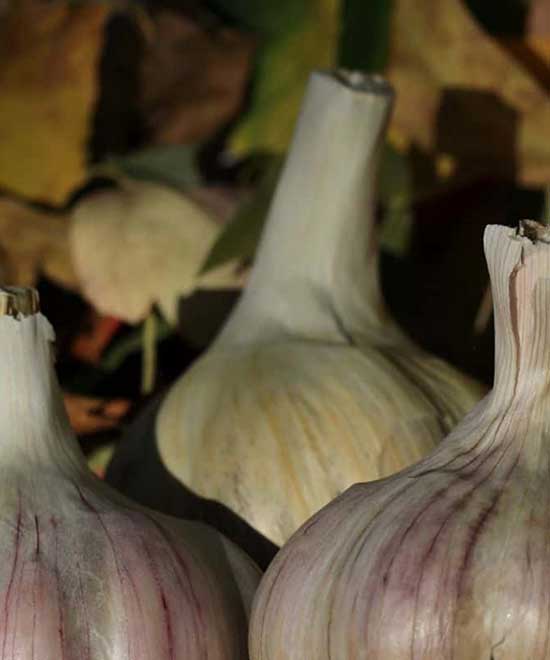
The names are pretty straightforward. Hardneck garlic (*Allium sativum* var. *ophioscorodon*) grows a rigid central stalk called a scape that eventually produces a flower. All hardneck varieties do this — it’s one of the defining characteristics of the group. Softneck garlic (*Allium sativum* var. *sativum*) has a flexible stem that stays soft and pliable, which is why you can braid softneck garlic but you can’t really do that with hardneck.
Hardneck garlic is more closely related to wild garlic and it’s the one that garlic enthusiasts and chefs tend to get excited about. The flavors are more complex and interesting, the cloves are usually bigger, but you typically get fewer cloves per bulb. Hardneck typically needs a cold period called vernalization to form a proper bulb, so it does best in colder climates with real winters. Porcelain and Rocambole in particular are genuine cold climate garlics that will struggle in any climate with short winters or hot summers, and that matches up pretty well with what I’ve seen here in Northern California at our farm where we are on the cusp of where you can grow these garlics.
Softneck garlic is what you’ve been buying at the grocery store your whole life. It stores longer, it’s easier to grow commercially, and it produces more cloves per bulb even though they tend to be smaller. It’s more adaptable to different climates and doesn’t necessarily need that cold snap, which is why the big commercial operations gravitate toward it.
Hardneck Subgroups
Hardneck garlic has seven commonly recognized subgroups:
- Rocambole
- Porcelain
- Purple Stripe
- Marbled Purple Stripe
- Glazed Purple Stripe
- Asiatic
- Turban
Let me walk through each one.
Rocambole
Rocambole is the one that a lot of garlic lovers consider the gold standard for flavor. If you’ve ever heard someone talk about “gourmet garlic” or “fresh market garlic” they’re probably talking about a Rocambole. These have this incredibly rich, deep, true garlic flavor that’s complex and full and a little nutty without being harsh. The scapes produce the characteristic double loop curl that all hardneck garlic is known for, but Rocambole scapes are especially tight and recognizable once you know what to look for.
The bulbs typically have 7 to 12 cloves arranged in a single ring around the central stalk, and the skins are loose and brownish which makes them really easy to peel. The downside is they’re one of the shorter storing hardneck varieties at around 5 to 6 months. They also hate excess water in the soil and prefer cold winters, so they can be a little finicky. They’re widely considered the best tasting garlic out there but also the most challenging to grow, and I’d agree with that.
Common Rocambole Varieties:
- Spanish Roja — Probably the most well-known Rocambole. Rich, deep, sweet, nutty and spicy flavor. Does best in northern climates. 7 to 9 cloves per bulb.
- German Red — A medieval strain said to have been brought to North America in the 1700s. Spicy and pungent. 6 to 12 cloves per bulb.
- Killarney Red — A large, easy to grow Rocambole. 8 to 9 cloves per bulb with great deep garlic flavor.
- Amish — Grown by the Amish in Wisconsin for over 40 years. Large bulbs with 8 to 10 cloves.
- Carpathian — An Eastern European variety with rich, sweet undertones.
Porcelain
Porcelain garlic is one of my personal favorites and it’s the group that includes Music, which we grow here at Basaltic Farms. These are the showstoppers. The bulbs are big and beautiful with thick, bright white papery wrappers and the plants themselves grow tall — some reaching 4 to 6 feet including the scape.
What really sets Porcelain apart is the clove size. You typically only get 4 to 7 cloves per bulb, but those cloves are massive. They have a bold, strong garlic flavor that holds up really well in cooking and they’re among the longest storing hardneck varieties. Multiple sources report Porcelain storage at 6 to 10 months under good conditions, which is impressive for a hardneck. They’re cold tolerant which makes them great for northern growers.
Common Porcelain Varieties:
- Music — We grow this one at Basaltic Farms. The most widely planted Porcelain in North America. 4 to 7 cloves per bulb. Bold, classic garlic flavor.
- Georgian Fire — Hot and robust with hints of heat that come through raw. Beautiful white bulbs.
- German White — A dependable variety that produces consistently large bulbs. Stores well.
- Romanian Red — Rich, complex flavor with a bit of heat.
- Majestic — Lives up to its name with large, beautiful bulbs.
Purple Stripe
Purple Stripe garlic is special because genetic studies have shown it to be the original line of garlic from which all other garlics evolved. It’s the ancestor variety — as garlic adapted to new countries and climatic regions throughout the world, all the other subgroups branched off from Standard Purple Stripe.
The bulbs are gorgeous with vivid purple striping on the outer wrappers and deep purple to red clove skins underneath. They produce 7 to 12 cloves per bulb with a distinctive elongated crescent shape. The flavor is rich and sweet, and these are widely considered the best baking garlics you can get. Storage for Purple Stripe varieties generally runs 4 to 8 months, though individual varieties and growing conditions make a big difference.
Common Purple Stripe Varieties:
- Chesnok Red — We grow this one. About 12 cloves per bulb, nearly all medium. Originated in the Republic of Georgia. Wins every baked garlic taste test.
- Persian Star — Discovered at a market in Samarkand, Uzbekistan. 6 to 8 cloves per bulb.
Marbled Purple Stripe
Marbled Purple Stripe is closely related to the standard Purple Stripe but with some key differences. The bulb skins have a beautiful purple-marbled appearance and the wrappers tend to be thicker. The cloves are fewer and larger, typically 4 to 8 per bulb with amazing rich, strong, spicy garlic flavors. Storage runs about 6 to 9 months.
Common Marbled Purple Stripe Varieties:
- Metechi — A bold, fiery variety from the Republic of Georgia.
- Siberian — Mild and delightful with very little heat.
- Russian Giant — Large bulbs with striking purple marbling and strong, full-bodied flavor.
Glazed Purple Stripe
Glazed Purple Stripe garlic is something to look at. The bulb wrappers have an almost metallic, waxy quality to them that shimmers in the light with hints of silver and gold — multiple garlic growers describe the skins as glass-like. These typically have 7 to 12 cloves per bulb. The flavor is strong and earthy and they’re best as a cooking garlic. Storage runs 6 to 8 months.
Common Glazed Purple Stripe Varieties:
- Purple Glazer — The most widely available variety in this subgroup. Beautiful iridescent bulbs.
- Red Rezan — The bulb wrappers have that signature glazed shimmer. Lovely flavor.
Asiatic
Asiatic garlic is one of the early birds of the garlic world and it’s an interesting group because it sits somewhere between hardneck and softneck behavior. They’re classified as “weakly bolting” which means they produce a scape as a stress reaction in colder climates but won’t produce one in warmer climates. They typically produce 4 to 8 large wedge-shaped cloves with a hotter, spicier flavor profile. Storage runs about 5 to 7 months.
We grow Korean Mountain here at Basaltic Farms, and it’s a variety I’m really glad we added to our lineup. Korean Mountain typically produces 7 to 9 cloves per bulb — big, firm cloves with good garlicky flavor that starts with a nice hit of heat and mellows out. The bulbs tend to be a little rough in shape with papery wrappers, and they’re known for producing huge bulbils. It stores up to about 6 months if you cure it well.
Common Asiatic Varieties:
- Korean Mountain — We grow this one. Bold, robust flavor with initial burst of heat. 7 to 9 cloves per bulb.
- Asian Tempest — Bold, hot variety with large cloves and vibrant purple striping.
- Korean Red — Rich garlic flavor with moderate heat. 6 to 8 cloves per bulb.
- Pyongyang — Complex flavor profile.
Turban
Turban garlic gets its name from the turban-shaped flower head it produces. Like Asiatic, it’s a weakly bolting type. They’ve fast become one of the most popular commercial and homegrown groups because of the range of climatic tolerances and their sweet, complex flavors. The bulbs are typically flattened globes with purple striping and they contain 5 to 9 large, fat cloves. Storage is shorter at 4 to 7 months, but they’re generally the first garlic ready for harvest each season.
We also grow Thai Purple here at Basaltic Farms, which is our Turban variety. Thai Purple is extremely adaptable — it handles cold northern climates and hot dry climates equally well. The outer skin is pinstriped with attractive silky white and amethyst stripes, and the flavor is bold and pungent with moderate to strong heat when eaten raw that mellows nicely when cooked. It typically produces 9 to 11 cloves per bulb and stores 6 to 7 months.
Common Turban Varieties:
- Thai Purple — We grow this one. Bold, pungent flavor. 6 to 8 cloves per bulb. Great adaptability.
- Tzan — A favorite for slicing and sautéing with butter. Mild, pleasant flavor.
- Chinese Purple — Purple-striped bulbs with rich, hot flavor.
- Shantung Purple — Purple blushed bulbs with a mild flavor for a Turban.

Softneck Subgroups
Softneck garlic has only two subgroups:
- Artichoke
- Silverskin
Artichoke
The bulbs are usually large and somewhat flattened, with cloves arranged in 3 to 5 layers. References often put this subgroup at 12 to 20 cloves per bulb, but across our own harvests our four Artichoke varieties have run closer to 7 to 13, which is exactly why the documented numbers below are worth more than a generic figure.
We grow four Artichoke varieties here at Basaltic Farms — Inchelium Red, Sicilian Artichoke, Red Toch, and Susanville — and I know these ones inside and out.
Common Artichoke Varieties:
- Inchelium Red — We grow this one. A celebrated heirloom found on the Colville Indian Reservation in Washington State. Won the 1990 Rodale Kitchen taste test.
- Sicilian Artichoke — Another one we grow. Mediterranean heirloom with a spicy kick that mellows to mild sweetness.
- Red Toch — We grow this one too. Originally from the Republic of Georgia. Mild, complex flavor.
- Susanville — Our fourth Artichoke variety. From Northern California. Mild, rich flavor great for roasting.
- California Early — The generic garlic most people think of. Grown in huge quantities around Gilroy.
- Lorz Italian — Originally from Italy. Semi-rich flavor with a lot of bite.
- Polish White — Consistently productive with large bulbs.
Silverskin
Silverskin garlic is the last to mature each season and it stores the longest of any garlic type — 10 to 12 months under the right conditions. The bulbs are packed with cloves — sometimes 15 to 24 per bulb. The flavor tends to run hot and aggressive. No other garlic braids better than Silverskin.
Common Silverskin Varieties:
- Nootka Rose — A gorgeous heirloom from the San Juan Islands. 15 to 20 cloves per bulb. Bold, robust taste.
- Idaho Silver — Reliable variety well-suited to northern growing regions.
- Chet’s Italian Red — Hot and spicy with attractive red-tinged clove wrappers.
Basaltic Farms Varieties: Clove Counts and Seed Value
Now here’s the part where I can really get specific because these are the varieties I know from growing them year after year on our farm. I’ve handled thousands of these bulbs and I know exactly what you’re going to get.
Before I get into the individual varieties, here’s something important to understand about clove sizes and how they relate to seed value:
| Size | Cloves per Pound | Seed Value |
| Small | N/A | Small cloves do not have value as seed |
| Medium | 100 to 120 | Decent to good for planting |
| Large | 60 to 70 | Ideal for planting |
| Jumbo | About 50 | Premium seed |
This matters a lot because when you’re buying seed garlic, you want to know how many plantable cloves you’re actually getting per pound. Bigger cloves generally produce bigger bulbs, so the large and jumbo sizes are what you really want for planting.
Even though I’ve grown these and handled many bulbs over the years not every bulb is exactly the same and the values below are very close approximations based on repeated clove counting for the varieties we grow.
Music (Porcelain — Hardneck)
Music is one of our hardneck garlic varieties and it’s probably the most popular Porcelain garlic in North America. It’s reliable, it’s flavorful, and those big beautiful cloves are a joy to work with.
Music has 4 to 7 cloves per bulb with many being large. With smaller bulbs most are medium to large in size. It stores well for a hardneck at around 7 to 9 months and the plants grow tall and strong in our volcanic soil. The bold, strong flavor holds up in cooking and it’s versatile enough to use raw or roasted.
/chesnok-red-garlic/Chesnok Red (Purple Stripe — Hardneck)
Chesnok Red is our Purple Stripe variety and it’s the one that really opened my eyes to how different garlic varieties can be. The first time I roasted a bulb of Chesnok Red and tasted that incredible sweetness, I couldn’t believe it came from garlic.
Chesnok Red has about 12 cloves per bulb with nearly all of them being medium with occasional large cloves from the biggest bulbs. It originated in the Shvelisi region of the Republic of Georgia and does well in our Northern California climate with the cold winters we get.
Inchelium Red (Artichoke — Softneck)
Inchelium Red is one of our softneck garlic varieties with a really cool history. It was found growing at an old homesite on the Colville Indian Reservation in Washington State and it won the 1990 Rodale Kitchen taste test.
Inchelium Red has 7 to 12 cloves per bulb, averaging about 9. The flavor is mild and rich with medium heat that actually increases during storage. Stores 6 to 9 months and adapts to zones 3 through 10.
Sicilian Artichoke (Artichoke — Softneck)
Sicilian Artichoke is our spicy softneck option and it’s an ancient Mediterranean heirloom. Sicilian Artichoke has 7 to 13 cloves per bulb, averaging about 10. The flavor starts with a distinctive spicy kick that transitions to mild sweetness. Stores 8 to 12 months.
Red Toch (Artichoke — Softneck)
Red Toch is our heritage variety from the Republic of Georgia, originally from the village of Tochliavri. Red Toch has 7 to 12 cloves per bulb, averaging about 10. The flavor is balanced — not too mild, not too hot. Stores up to 9 months.
Susanville (Artichoke — Softneck)
Susanville is our mildest softneck and it’s a California heirloom that’s rumored to be a superior variant of the widely grown California Early. The exact origin is unknown, but the variety most likely came from the town of Susanville, California, which is the county seat of Lassen County. Our farm in McArthur is only about 90 miles west of Susanville, so we’re growing in the same kind of Northern California mountain climate.
Susanville has 7 to 13 cloves per bulb. This is the variety I recommend for people who want garlic presence in their cooking without getting overwhelmed. Matures early and stores 6 to 9 months.
Thai Purple (Turban — Hardneck)
Thai Purple is our Turban variety and one of the most adaptable garlics we grow. It handles cold northern winters and hot, dry summers about equally well, which is rare. The outer skin is pinstriped with silky white and amethyst stripes, so it’s a genuinely beautiful bulb on the table.
Thai Purple has 9 to 11 cloves per bulb, and the flavor is bold and pungent with moderate to strong heat when raw that mellows nicely once cooked. It stores 6 to 7 months, and as a Turban type it’s usually one of the first varieties ready for harvest each season.
Korean Mountain (Asiatic — Hardneck)
Korean Mountain is one of our hardneck varieties and it’s an Asiatic type, which makes it one of the earliest garlics we pull each season. It’s a variety I’m really glad we added to our lineup. The bulbs have a rough, rustic look with papery wrappers, and the flavor has real backbone.
Korean Mountain has 7 to 9 cloves per bulb, and they’re big, firm cloves that are a pleasure to work with. The flavor starts with a nice hit of heat and then mellows out, which makes it versatile in the kitchen. It stores for around 6 months, and as a weakly bolting Asiatic it handles a range of climates well.
Quick Reference: Clove Counts at a Glance
| Variety | Type | Subgroup | Cloves/Bulb | Large+ Cloves | Storage |
| Music | Hardneck | Porcelain | 4–7 | Most are large | 7–9 months |
| Chesnok Red | Hardneck | Purple Stripe | ~12 | Few, mostly medium | 5–7 months |
| Korean Mtn | Hardneck | Asiatic | 7–9 | Most are large | ~6 months |
| Thai Purple | Hardneck | Turban | 9–11 | Most are large | 6–7 months |
| Inchelium Red | Softneck | Artichoke | 7–12 | Mixed sizes | 6–9 months |
| Sicilian Art. | Softneck | Artichoke | 7–13 | Mixed sizes | 8–12 months |
| Red Toch | Softneck | Artichoke | 7–12 | Mixed sizes | Up to 9 mo |
| Susanville | Softneck | Artichoke | 7–13 | Mixed sizes | 6–9 months |
Why This Matters
There’s a reason garlic enthusiasts talk about varieties the way wine people talk about grapes. Each one has its own personality, its own strengths, and its own place in the kitchen. That cheap imported garlic at the grocery store isn’t giving you any of that — it’s just generic flavor, and half the time it’s been treated with chemicals and bleached before it even gets to the shelf. When you grow real varieties or buy them from farms that care about what they’re producing, the difference hits you immediately.
Understanding garlic varieties and their clove counts matters whether you’re a home gardener trying to figure out how much seed garlic to buy, a chef looking for the perfect variety for a specific dish, or someone who’s just curious about why the garlic at the farmers market tastes so much better than what comes from the store. Once you start exploring the world of certified organic garlic varieties, there’s really no going back to the generic stuff.
We grow all of these varieties here at Basaltic Farms in our volcanic soil, and every single one of them has its own personality and its own place in the kitchen. If you’re not sure where to start, I’d say grab a few different varieties and do a side-by-side taste test — roast one of each and see which one speaks to you. That’s how I fell in love with garlic, and I’ve got a feeling it’ll work for you too.
Planning your fall planting? You can browse our certified organic seed garlic whenever you’re ready. Pre-order now; ships in September.
Resources
These are some of the sources I’ve referenced and learned from over the years while building my understanding of garlic taxonomy, variety characteristics, and growing practices:
- Tasmanian Gourmet Garlic — Letitia Ware’s comprehensive garlic variety database. An invaluable resource for understanding subgroups and variety characteristics.
- Filaree Organic Seed Farm — One of the oldest and most respected seed garlic farms in the U.S.
- Botanical Interests — Garlic: Which to Choose? — Solid overview of garlic groups with good detail on storage life.
- Garden Betty — How to Cure and Store Garlic — Helpful breakdown of storage life by garlic type.
- Hood River Garlic — Certified organic seed garlic farm with reliable variety data.
- Gourmet Garlic Gardens — Extensive variety profiles with growing history and flavor notes.
- Mad River Garlic Growers — Good source for Asiatic variety information.
- Door County Garlic — Detailed variety descriptions with clove counts and storage data.
- The Beginner’s Garden — Best Types of Garlic — Accessible guide to garlic types organized by climate.
- Garlicloves — Useful descriptions of Purple Stripe subgroups.
About This Guide
I put this guide together from my own knowledge and from things I have learned from reading. It is not infallible and will be updated when discrepancies are found. I have grown some but not all of the varieties mentioned in this blog. As we grow more types i will update my data with my real world finds.
Additional Blog Posts You Might Be Interested In
What is Seed Garlic?
Commercial Garlic Farming Guide
How Much Garlic to plant?
Top 10 Organic Garlic Farms in the USA